menu
close
close
Submarine history spans 250 years of new ideas and discoveries. From hand-powered boats to nuclear vessels, advances in science have changed how people travel and work underwater.
In 1776, inventor David Bushnell built the Turtle, a small submarine that one person could operate by hand. During the American Revolution, the Continental Army used it in an attempt to attack the British warship HMS Eagle.
Although the attack failed, the Turtle helped launch a new era of naval warfare.
At first, submarines relied on people to turn their propellers. However, inventors soon began searching for better ways to power these vessels.
During the 1800s, engineers tested steam, gasoline, and electric engines. Eventually, diesel-electric systems gave submarines greater range and more reliable power.
Diesel engines moved the vessels on the surface and charged their batteries. Meanwhile, electric motors powered them underwater.
During World War I, German U-boats showed the value of long-range underwater travel. Their engines allowed crews to cross great distances.
By World War II, submarines had grown larger and more powerful. However, they still faced limits on underwater speed and travel time.
New tools, including radar and sonar, helped crews find other ships and navigate more effectively. As a result, submarines played a greater role in naval warfare.
On January 21, 1954, the United States launched USS Nautilus, the world’s first nuclear-powered submarine.
Unlike diesel engines, nuclear reactors do not need oxygen from the air to produce power. Therefore, crews could stay underwater much longer without surfacing.
In January 1955, Nautilus began traveling under nuclear power. This breakthrough changed submarine design and naval operations.
Alongside new engines, engineers searched for ways to help submarines move faster underwater.
In 1953, the U.S. Navy launched USS Albacore to test a new hull shape. Its smooth, teardrop design reduced water resistance.
Consequently, this shape helped submarines travel faster and turn more easily. Engineers later used similar designs in modern vessels.
Today, modern submarines combine nuclear power, advanced sensors, improved hulls, and life-support systems. Together, these tools allow crews to spend months at sea and long periods underwater.
Nevertheless, engineers continue searching for ways to make these vessels safer and more efficient.
What will the next great breakthrough bring? Although nobody knows for certain, 250 years of submarine history show that new ideas continue to shape the future.
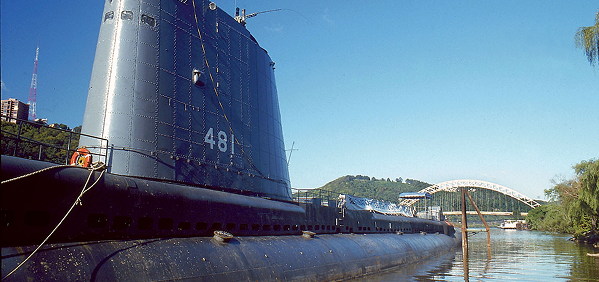
Discover life underwater aboard USS Requin (SS 481) at Kamin Science Center. This historic Cold War-era vessel gives visitors a firsthand look at submarine life.
Additionally, explore the U.S. Navy’s history of the Turtle to learn more about early submarine design.
Click the link below to find out more about submarines: